Laresa_kosloff
Laresa_kosloff

Current Projects | Super 8 Films | Drawings | Text | About | Contact

New Diagonal | Standard run | The Velodrome Project | Spirit & Muscle | Deep & Shallow | Feeling for You | Wherever you are |

New Diagonal


New Diagonal
Production still: Alex Martinis Roe
Digital video (3 min)
2007


New Diagonal is a choreographed video work that combines various movements from fast track athletics, aerial skiing, high diving, cycling, and yoga. These movements are performed in relation to a three dimensional triangle, which provides physical support for the body throughout the routine. New Diagonal explores how movement and gesture translate into significance. This video was first exhibited as part of a painted sculptural object, extending Kosloff’s interest in the formal and conceptual dynamics of sport, abstraction and formalism.


New Diagonal
Plinth, painted dowel sticks, and television monitor
Ocular Lab, Melbourne, 2007
Installation view: Andrew Curtis


New Diagonal
Plinth, painted dowel sticks, and television monitor
Ocular Lab, Melbourne, 2007
Installation view: Andrew Curtis


BACK TO TOP


Standard run


Standard run
Series of still images from video
Super 8 film transferred to video (1 min 36 sec)
2007

Standard run is an attempt to ‘physically draw’ a method of running. The work extends Kosloff’s exploration of representations of ‘the real’, by manipulating qualities of stillness and action, mimicry, repetition, time, saturated colour, and painted backdrops. The work refers to a variety of cultural influences such as: early representations of movement in photography, sport, slapstick comedy, instructional films, 70s video art, synchronized dance, classical poses, and the culture of the ‘trained’ body. Combining and referencing these elements, Standard Run explores culture in relation to nature, the body as a machine, and the ‘objective truth’ of cameras; transforming time, space and its perception into a series of still images.


BACK TO TOP


The Velodrome Project


The Velodrome Project
View from stadium seating
Photo: Bianca Hester
25/11/2006

The Velodrome Project
Collaboration with Alicia Frankovich, 2006

The Velodrome Project was a one-day public event held at the Brunswick Cycling Velodrome in Melbourne, Australia, 2006. Kosloff and Frankovich made three sculptural works on the velodrome field area; a large black circle painted directly onto the grass, a wooden section of roller coaster (based on the ‘The Big Dipper’ in St. Kilda), and a large, blue stretched canvas (6mt x 4mt), which was held perpendicular by a wooden frame.

The audience was invited to view this spectacle as part of a one-day event, which included gymnastic performances by the artists, and a ‘sculptural’ performance with a parachute. The Brunswick cycling club participated in the event by conducting training sessions throughout the day. This ‘home-made’ spectacle was viewed from stadium seating. Barbeque sausages and catalogues (with an essay by Alex Martinis Roe) were available.

Video documentation of The Velodrome Project has been exhibited at Careof gallery in Milan, and as part of Gang Green Artist Garden Party, curated by Daniel Du Bern in Wellington, New Zealand. Kosloff and Frankovich are interested in how video documentation of the event is altered by the context of conventional gallery settings. A series of still photographic images has also resulted from The Velodrome Project.


The Velodrome Project
View from across field area
Photo: Bianca Hester
25/11/2006


The Velodrome Project
Series of still images from video documentation
Filmed by Alex Martinis Roe
Digital video (5 mins)
2006


BACK TO TOP


Spirit & Muscle


Spirit & Muscle
Digital video (4 min 39 sec)
Production still: Christian Capurro
2006

Spirit & Muscle 2006

This choreographed video work refers to a range of cultural interests including sport, Modernist abstract art, dance, and cartoons. These unlikely combinations play with perceptions of ‘high’ and ‘low’ art, as well as awkwardness and control, nature and culture, individualism and standardization. The work indirectly refers to early Cubist experiments by Picasso, Bauhaus dance performances, and the performing body in early video art. By literally inserting the female body into a canvas form, Spirit & Muscle lightheartedly deconstructs the phallocentric male canon in painting and art history, drawing attention to gender divisions and assumptions.


Dizzy pupil
Series of still images from video (1 min)
2006


Dizzy pupil (left) Spirit & Muscle (right)
Digital video projections
New ’06, curated by Juliana Engburg, A.C.C.A, Melbourne, Australia, 2006
Installation view: John Brash


BACK TO TOP


Deep & Shallow


Deep & Shallow
Still images from digital video (4 mins)
2004

Deep & Shallow 2004

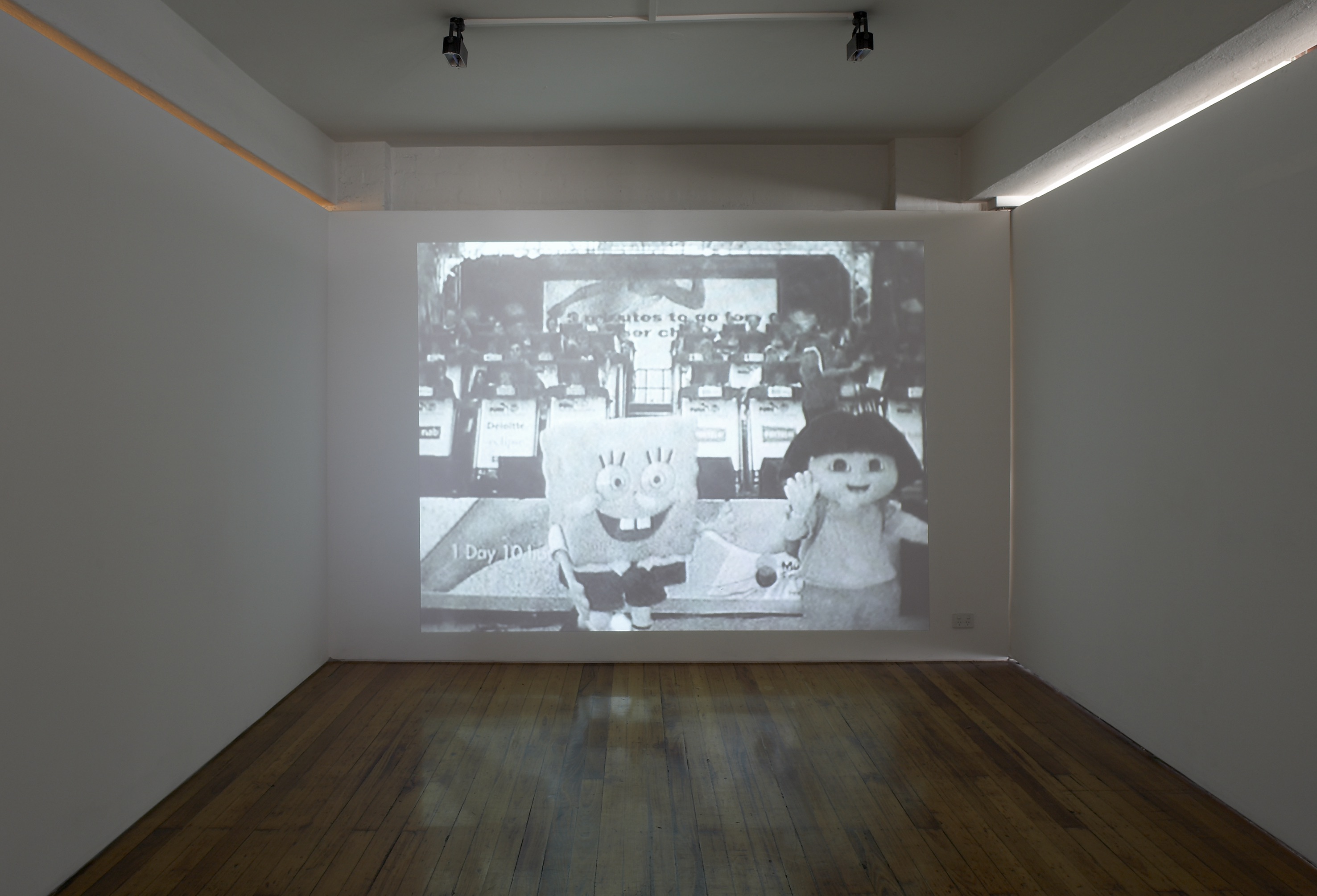
Deep & Shallow is a video work that investigates characterization, group dynamics, power, inclusion, exclusion, and ritualized behavior. A group of six women wearing garbage bag costumes enact a series of movements and spatial explorations within an all white studio environment. Kosloff is interested in how choreographed scenarios, repetition, and physical gestures might translate into signification. The work refers to both popular culture and ‘high art’, paying equal homage to children’s television, cartoons, and formalism.


Deep & Shallow 2004
Dvd on six flat screen monitors
Make it Modern, curated by Juliana Engburg, Deloitte oiffice, Melbourne, 2005
Installation view: John Brash

Make it modern

Curated by Juliana Engburg, Deloitte office, Melbourne, Australia, 2005
Excerpt from catalogue essay by Juliana Engburg

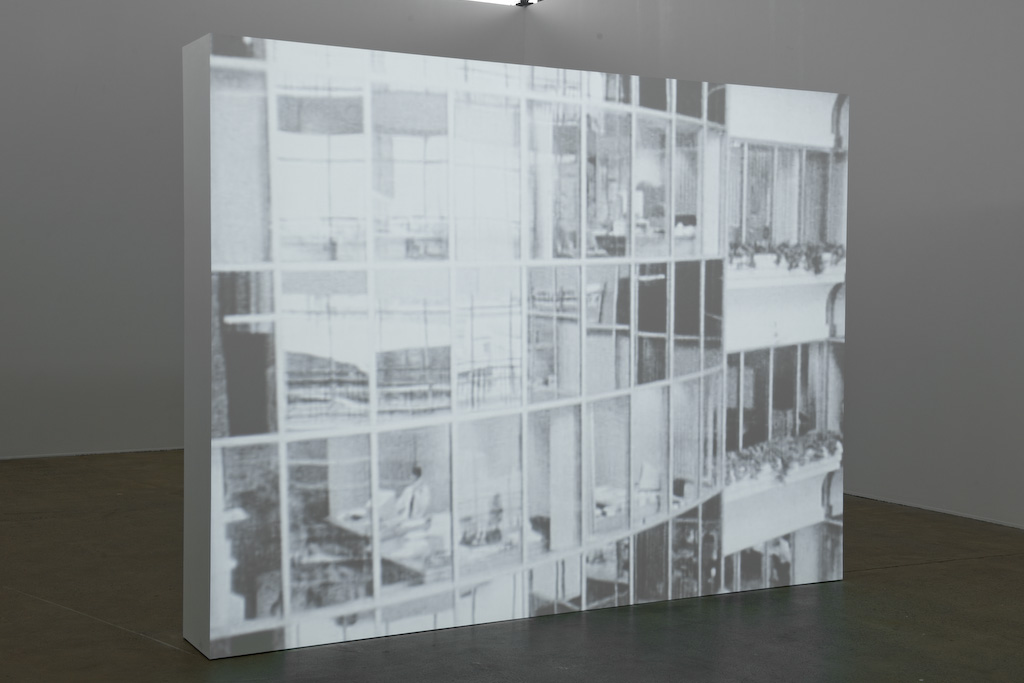
“The construction of modernism as a set of abstract, yet tangible shapes can be traced through the twentieth century. But perhaps most vividly, the colour, space and shape experiments of the Bauhaus, in Germany, provided the blueprint for the sturdiest of modernist trajectories. In Melbourne that legacy is all around us: in the primary colours employed by DCM architects, in the stylish swish of Frederick Romberg’s buildings, and in the modernist glass-curtain wall buildings, of which Deloite’s home in the BHP Billiton building, is a most apposite current example.”

“Her video project Deep & Shallow also references the early design and painting experiments of the Bauhaus. Kosloff’s figures – clad in what appears to be black hessian bags that enclose their upper body, but leave their legs naked – arrange themselves around a set of molecular 3D line and dot, square and solid space diagrams. Her figures enact deep and shallow space, in a renovated action of performance painting and theatrical sculpture. The paintings of Surrealist Jean Miro, the theatre costumes of Bauhaus designer Oscar Schlemmer, and drawings of Paul Klee, all seem to be evoked in Kosloff’s playful performance, which in turn refers to the modernist workshop of experimentation.”

Fellow Anthropoid

Curated by Phillip Watkins, CAST gallery, Hobart, Australia, 2005
Excerpt from catalogue essay by Phillip Watkins

“The dilemma of the degree to which the formation of identities becomes compromised (through the appeal and response of communication) is in Laresa Kosloff’s Deep & Shallow. The bagged figures that ritualistically enact nonsensical or arcane performances, acquire character and identity through their interaction with one another; a gestural give and take that we as observers read as significant in some way. But for all these distinctions, which increase the more you watch them, the figures themselves are, it seems, a priori anonymous, abstract; all signs of integral difference made void through the masking of face and upper body. Their uniformity, carefully considered by Kosloff, (to the extent that each participant was chosen on the basis that their physique matched that of the artist) rather than suggesting a gagging of individuality, creates a being prior to it, prior to consciousness itself even. Consequently the figures take on the pathos of tragicomic metaphor; a portrait of humanity, physically isolated and vulnerable, yet reassured and defined by the need for social contact and boundaries; they also suggest a denial of the assumed independence of individualism, becoming (particularly in the light of Kosloff’s choice of cast) a multi-faceted self portrait.”


BACK TO TOP


Feeling for You


Feeling for You
Still image from animation (2 mins 25 sec)
2002

Feeling for You 2002

This hand-drawn animation is an imaginary self-portrait, in which Kosloff executes a complex dance routine involving break-dance moves. By recreating rapid movement through drawing, Kosloff explores the limitations of two-dimensionality in relation to the imaginative possibilities of drawing.


Drawn Out
Curated by Renai Grace, Blindside gallery, Melbourne, 2004
Excerpt from catalogue essay by Renai Grace

“The theme of fantasy in relation to the human body is prevalent in Kosloff’s animations. Feeling for You (a self portrait) and Themogenic Muscle Detonator (a collaborative work with Lucy Guerin Dance Company) use stop-frame animation and pop culture sound to create short narratives about the fantasy of dancing the way you want to. Influenced by music video clips, Kosloff has constructed a false reality in which animations are able to physically achieve the unachievable, in humorous, jerky compressed-time movements. Her animations have influenced the choreography of the movements by carrying the formal concerns of drawing through to dance practice; Kosloff links the improvisations and gestures that underpin both drawing and dance by emphasising the way both disciplines rely on movement of the body through space with the principal difference being that in drawing, unlike dance, marks remain behind as an after-trace.

Kosloff treats her drawings as objects as she obsessively cuts out tiny drawings ranging in scale from 1cm high, mounts them in a white void and spot lights them before recording them onto video. Reminiscent of a paper doll, the figure becomes the focus of the work. Not unlike Whiteley’s early drawing series of a figure in the bathroom, Kosloff’s drawings are simple in content and form; they appear to float in an empty white space.

Kosloff has used technology to mediate her presentation of the drawings. At the same time, her works obviously resist technological gimmickry as she strips down the drawing to a linear image and reduces movement of the animation to the barest necessity.”


BACK TO TOP


Wherever you are ...


Wherever you are…
Still from found Super 8 film
Super 8 film transferred to video (9 mins 20 sec)
2003

Wherever you are… 2003

The Victorian Movie Makers club was based in Fitzroy, Melbourne, from 1938 – 2001. The club had 160 members, who made scripted films, documentaries, and comedies using 16mm and Super 8 film. Members met regularly to watch their films, and held award nights, fundraisers, and an annual Christmas dinner. In 2001 Kosloff met with the remaining members at their final meeting, and was given a box of discarded Super 8 movies.

In 2003 Kosloff edited these Super 8 films, and digitally projected them onto a Minimalist inspired sculpture, which became a kaleidoscopic filter. Mirrored Perspex inside the triangular object converted holiday movie footage into moving abstract geometric patterns. Wherever you are… combines ‘pure form’ with personal histories, investigating perceptual experiences of time and space in relation to memory.


Wherever you are…
MDF, mirror, perspex, dvd projection
1250mm x 1440mm x 400mm
Installation view: Christian Capurro
Studio 12, Gertrude Contemporary Art Spaces, Melbourne, 2003


BACK TO TOP